The 6.0.1 update for FCP back in June added support for the AVCHD format. There's a document out now from Apple that describes all of the limitations of support (e.g., doesn't work on PowerPC Mac's.) Here's a good write-up on the current status of AVCHD support for FCP.
AVCHD is mainly a consumer-oriented format. Panasonic has actually used AVCHD within its pro line of cameras with the small AG-HSC1U. According to Digital Camcorder News, the Sony HDR-SR7 and HDR-CX7 AVCHD cameras are the most popular camcorders among its visitors. Canon recently introduced a tapeless camcorder HG10 that uses AVCHD to record.
Wednesday, October 17, 2007

Tuesday, October 16, 2007
iFlop
Just to prove I'm not a shill for Apple, here are a couple of their recent disappointments.
Back at NAB, Apple announced that Final Cut Server would be available by the summer of 2007. I gave it a positive plug at the time. Well summer came and went with nary another peep from Apple about Final Cut Server. Recently, Apple added to the FCS webpage a release date of "early 2008". I'm guessing we won't see it again until NAB 2008. Apple isn't known for vaporware, but this is a prime example.
"iFlop"
While I don't agree with everything in this article from Forbes, the Apple TV has had a disappointing run. While expecting it to become the iPod of the television might have been pushing it, even Steve Jobs went on to call the Apple TV a mere "hobby". Here is one of my old plugs for Apple TV where I hoped it would become a great platform the video podcasts like our Mosaic.
For me one of the big problems is that the product is basically designed only for high-def TV's, but Apple doesn't really have any high-def content. My guess is that this isn't mainly Apple's fault. I blame the entertainment companies who I think are afraid that Apple will corner the video market like they have cornered the music download market. Universal in particular has been playing hardball with Apple on its NBC TV Shows and and is trying to organize some other record labels for a competing music service. Another big feature missing on Apple TV is movie rentals. Steve Jobs has said that people want to "own" their music (I agree), so is that his view on movies or the entertainment companies'?
Just look at the HD-DVD and Blu-ray fiasco to see an example that the entertainment companies, not to mention the consumer electronics manufacturers, just don't get it. Most of the movies studios are only supporting either HD-DVD or Blu-Ray, not both formats. So if you want to watch Universal or Paramont pictures, then buy a HD-DVD player, but if you want Sony, 20th Century Fox, or Disney movies, then get a Blu-ray player. Average consumers would never buy into this crazy scheme. Each company is trying to maximize their own company's advantage to the detriment of the consumer and thus the overall market for high-def movies. For music, it took an explosion of illegal downloads, to scare the record labels into all buying into Apple's music store. Here's one advocate for doing the same thing for video ("Apple TV Fails to Tap the Net's Limitless Library").
Not that Apple is blameless in the content world. Apple will not let other hardware manufacturers make products that will work with iTunes or play content with Apple's DRM for music or video. And Apple won't add support for content from other DRM schemes on their hardware. When it comes down to it, Apple is probably just as evil as Microsoft or the entertainment companies would be. But at least Apple's products are nearly all universally strong in interface, ease-of-use, quality, and reliability.
Monday, October 15, 2007
The Hazards of CMOS Sensors
SENSOR ARTIFACTS AND CMOS ROLLING SHUTTER
An interesting write-up at DVX user on artifacts from CMOS sensors. All camcorders have traditionally used a CCD as the image sensor, but CMOS is making some serious in-roads. Sony in particular has really jumped on the CMOS bandwagon for its new prosumer/low-end pro cameras, like the V1 and the new PMW-EX1. Panasonic's offering on the other hand are sticking with CCD's. It's not surprising that the DVX forum, devoted to Panasonic's HVX-200 and the DVX-100, would have a few nasty words about the CMOS.
The CMOS artifacts they point out are smear, wobble, and partial flash. I've run into problems with fluorescent lights on CCD shots in stuff shot abroad. Nasty flickering in the video. With CCD's adjusting the shutter speed can help (see this previous post). But even this tip may not help if you are using a CMOS chip and get the partial flash artifact. In CMOS, the flicker will only affect certain parts of the frame at certain times. Similarly, flashes of light (e.g., from photographs) often only appear in parts of the frame. Read the article to understand why and see some scary examples.
The other scenarios where CMOS can be a serious problem are aerial shoot and shoots from a shaky platform, like a moving car.
[via FreshDV]
Thursday, October 11, 2007
Daisy-Chaining Firewire Drives
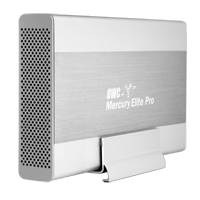 I've identified some serious problems with drive performance when daisy-chaining at Link TV. Daisy-chaining is a way to hook up multiple devices (in this case, hard drives) to one port (in this case, firewire). Firewire is theoretically supposed to handle 63 devices in one chain. I've been daisy-chaining firewire drives to FCP for 6 years, but Apple doesn't consider this a supported setup for editing.
Well, I've finally run into some real problems with daisy-chaining firewire drives. I've been seeing some real poor performance out of drives. Symptoms include aborted file transfers, the hanging up of the system when a movie is played, and very slow write performance. I think I've figured out the cause. There seems to be some problems mixing certain drives in one chain. In particular, I think certain drives from Other World Computing (OWC) don't play well with other drives, in particular drives from G-Technology, like the G-Raid. OWC makes the Mercury Elite Aluminum Pro drive and RAID. G-Technology makes the G-Drive and the G-RAID.
The workaround I've identified is to make sure that a chain of drives is all from one manufacturer. For example, in our dub room setup, the G-Drive is on a firewire 400 port and the OWC drives are on the Firewire 800 port. Our computers in Edit 2 & Edit 3 have PCI cards that add 3 firewire 800 ports. So there are a lot of ports there, and it's easier to segregate OWC and G-Technology drives.
So far I've been able to diagnose this problem by checking the read/write performance of drives when I think there is a problem. I've been using the SpeedTools utility QuickBench to check drives by running the Extended Test with 20-100 MB files. If you are seeing a drive read or write at 10 MB/sec or slower then something is seriously wrong. If you think daisy-chaining may be the issue, a quick way to check is to unplug all the drives except the one that is acting up. If you then retest the drive and performance is way up, then you probably are dealing with a problem with daisy-chaining.
I've seen other, less serious problems with daisy-chaining. My write speeds on G-RAID's drops by about half when they are daisy-chained. This is a nuisance, but it's never really interfered with my work. I'm not doing any capture of 10-bit video or anything too demanding luckily.
Monday, October 8, 2007
DIY Teleprompter
 Creativity to Spare claims that you can make a decent teleprompter with glass from a picture frame. I can't vouch for that, but it wouldn't cost any cash to check it out.
The tutorial also includes a link to a build-your-own teleprompter product (see image) that includes beam splitter glass, like that used for real teleprompters. Looks like about $100 for a good piece of beam splitter glass and for $250 you can get a kit that includes a stand (looks like it has adjustable height). Tutorial also includes links to free Mac software to flip your type, so that it looks right in a mirror.
For a full-featured product at the low-end, Prompter People offers a 15" Teleprompter with a stand and an LCD screen for $1299.
[via FreshDV]
Saturday, October 6, 2007
Canon's 24F Format in FCP
 "Final Cut Pro 6 Techniques: Editing with Canon’s 24F"
A short article on dealing with Canon's flavor of HDV at 24 fps and cutting with it in FCP. Canon's A1, G1, and XL-H1 all have this mode as an option, as well as 30F and good-old 60i.
But editing in 24 fps video isn't right for everyone. If you are going for a filmic-look and you're not mixing in footage that's 60i and and your distribution format is DVD--then 24 fps makes total sense. But 24 fps and all its various flavors that manufacturers have created, can cause lots of headaches in post. Here's a commentary on trying to work with 24fps for broadcast purposes over at Little Frog in High Def.
[via Digital Camcorder News]
Subscribe to:
Posts (Atom)